
Plumas County Parole vs Probation
Post-release supervision in Plumas County is split between county and state systems. Probation is usually tied to a Plumas Superior Court sentence or order. It can follow a jail term, replace a longer custody term, or appear with mandatory supervision, PRCS, alternative custody, electronic monitoring, or reentry planning. State parole is different. It follows a California prison commitment and is supervised by the CDCR Division of Adult Parole Operations, not the Plumas County jail.
The first question is where the person was released from. A person released from Plumas County Correctional Facility may have a court order or probation record even after the jail roster no longer lists the person. A person transferred from Plumas County to CDCR may later have parole-suitability records through the Board of Parole Hearings and supervision routing through DAPO. Mixing those systems can send a search in the wrong direction.
| Supervision Type | Who Handles It | Release Record Clue |
|---|---|---|
| County probation | Plumas County Probation Department | Plumas court sentence, probation order, or local supervision term |
| PRCS or mandatory supervision | Plumas County Probation and the court | Post-jail county supervision after a qualifying sentence or release plan |
| State parole | CDCR Division of Adult Parole Operations | CDCR release, parole status, BPH action, or DAPO routing |
| Parole suitability | California Board of Parole Hearings | State-prison hearing schedule or result, not a county jail release |
- Parole
- State supervision after a prison release or parole-suitability process.
- Probation
- Court-ordered local supervision that may follow, replace, or modify jail time.
- PRCS
- Post-release community supervision handled locally after certain state-custody releases.
- Discharge
- The end of a custody or supervision term when no further supervision remains for that term.
Verify Plumas County Post-Release Supervision
There is no single public Plumas County parole and probation search that proves every supervision status. Verification works best as a chain. The jail record can show whether a person left local custody. The court record can show whether probation, time served, a warrant recall, a sentence, or a transfer was ordered. Probation can route questions about appropriate local supervision matters. CDCR, BPH, DAPO, and California VINE serve state-prison and parole contexts.
- Check whether the person is still listed in Plumas County Citizen RIMS Incarcerated People. A released person may be gone from that current-custody view.
- Use Citizen RIMS Arrests for the booking pointer, case number, charges, and action language. The portal warns that listed people may already have been released, bailed, cited, transferred, or had charges dismissed.
- Request or review the Plumas Superior Court record for the sentence, probation order, revocation order, warrant action, or release paperwork.
- For local supervision, contact Plumas County Probation with the court context. Public pages do not mean all personal supervision details are open to any caller.
- For state parole, search CDCR or BPH resources, then use DAPO regional routing if the person was released from state prison.
- For custody-change notices, use VINE inmate check and confirm formal records through the originating agency.
Release-status anchor: a jail release does not prove probation, and a probation order does not prove the person is in jail. Match the supervision question to the court or corrections system that created it.
Plumas County Probation Office
Plumas County Probation is the local office for adult probation context, pre-sentence reports, sentencing recommendations, court appearances on probation matters, and local supervision programs. Its Adult Division page says officers assist the court with sentencing-related reports and recommendations and must understand sentencing laws and custody time credits. That makes the office central when a released Plumas County inmate is under a court-ordered local supervision term.
The Probation Department page and the Adult Division screenshot in the research set both support the same local route. The Adult Division page is useful because it describes court-facing probation duties rather than just listing a phone number.
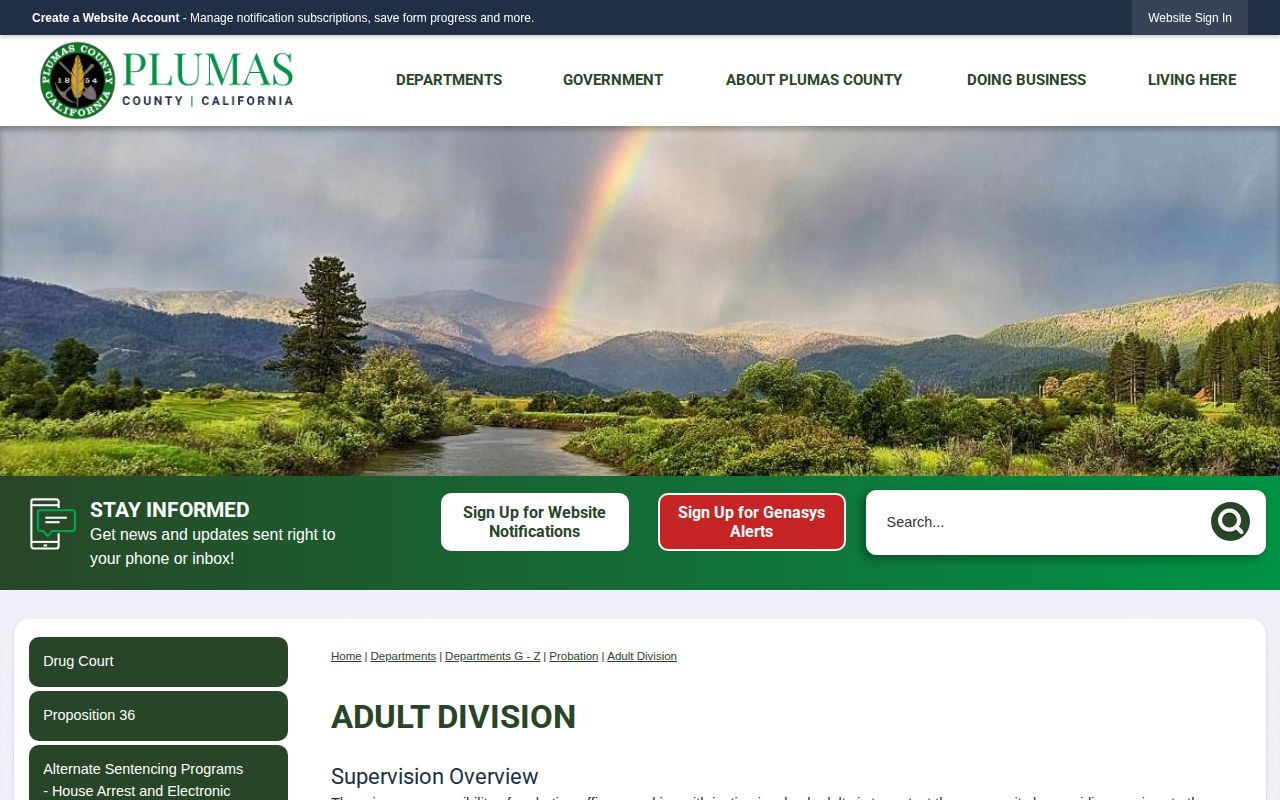
That local Adult Division context helps separate Plumas probation and PRCS from state parole, which is routed through CDCR DAPO.
270 County Hospital Road, Suite 128
Quincy, CA 95971
Phone: 530-283-6200
Fax: 530-283-6165
Plumas County Warrants and Absconders
A released person can later have a court or supervision problem. In Plumas County, the public Citizen RIMS Warrants route is only one clue. Its text warns that the list may not represent all active warrants, may include people already in custody elsewhere, may include resolved matters, and can lag. Newly issued warrants may not appear until at least 14 days old or longer. A warrant listing therefore needs confirmation through court records, law enforcement, or the supervising agency.
For county probation, a violation may lead to a court hearing, a warrant, modified terms, return to custody, or another sanction. For state parole, DAPO and CDCR records are the better route. VINELink can help with custody-status changes, but it is not a probation file or a court disposition. If a released Plumas County inmate disappears from the current jail view and later appears in a warrant context, treat those as different records until the court or agency confirms the link.
Note: Public warrant and custody tools can lag, so the court record is the stronger source for the legal status.
How Plumas Supervision Ends
Supervision ends by a legal action, not by disappearing from a roster. Local probation can end through successful completion, early termination when allowed, expiration of the term, modification, revocation, or a later court order. State parole can end by discharge from parole or another CDCR action. A jail roster will rarely explain that endpoint because the roster is built for current custody, not full post-release history.
For Plumas County, the durable record is usually in the court file, probation context, or state corrections file. The Plumas County released inmates path should be used when the first issue is whether the person left custody. After that, the supervision question moves to court, probation, DAPO, BPH, or records-request channels. California public-records law can support requests for releasable arrest and time-and-manner-of-release facts, but supervision notes may be limited by privacy, safety, sealed-record, and court restrictions.
Plumas CORP Reentry Support
Plumas County has a more specific reentry layer than many small counties. Community Corrections Partnership material names the Collaborative Offender Reentry Program, or CORP, as a way to streamline release processes, improve provider coordination, link incarcerated clients to programming, and support PRCS clients. The same material references Pre-Release Video Conferencing, PRCS transportation, electronic monitoring, GPS, Repath app monitoring, and drug or alcohol testing locations in Quincy and Portola.
This matters because a person may be outside the jail while still tied to a release plan, supervision term, electronic monitoring, or alternative custody condition. Those programs do not create a public released-inmate roster. They explain why the court and probation file can matter more than the jail page after release.
Plumas State Parole Hearings
For a Plumas County conviction that became a state-prison case, the California Board of Parole Hearings is a separate source. BPH posts parole-suitability hearing schedules and recent results. A suitability hearing decides whether a person should be released from prison, but a panel decision is proposed and becomes final within 120 days unless further review changes it. If the decision is vacated, another hearing may be scheduled months later.
The BPH hearing results page can confirm state-prison parole proceedings, while DAPO handles adult parole supervision after release. County probation and PRCS remain separate. A Plumas County jail release is not a BPH event unless the person was later in CDCR custody and eligible for parole consideration under state law.